Changes in Urban Heat Island and in Intra-Urban Demography Reshape Elderly Heat Exposure
Abstract
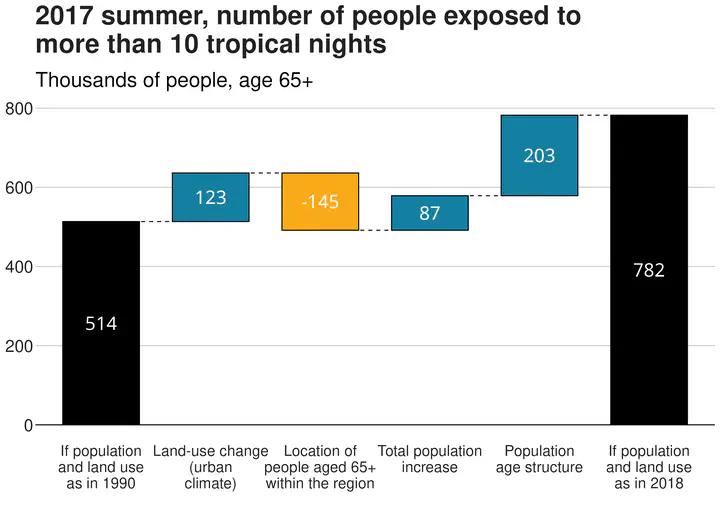
The number of elderly people potentially exposed to heat is an important metric for public health policies. This metric is expected to substantially increase in many developed countries due to the combination of climate change and population aging. However, existing assessments typically estimate future exposure by combining projected temperatures and demographic changes at coarse spatial scales, implicitly assuming that temperature and population are uniformly distributed within urban areas. Here, we quantify the bias introduced by this assumption by combining high-resolution climate simulations with fine-scale demographic data for the Paris metropolitan area (France). We assess, for the years between 2017 and 2022, to what extent accounting for the spatial heterogeneous changes in both urban temperatures and population distributions matters for assessing heat exposure of elderly people. We find that not taking into account these fine-scale dynamics systematically modify, by 22 to 48%, elderly people’s exposure to tropical nights. The evaluation bias is also widely variable from one year to another, as the urban heat island effect has different amplitude and extent depending on complex weather conditions. Our results demonstrate that future urban heat exposure depends not only on climate change and demographic growth but also on fine scale heterogeneities in the urban climate and in where older people are living within cities. These findings highlight the importance of integrating high-resolution climate and demographic information into large-scale heat exposure assessments, and the role that changes in intra-urban population distribution can play in adaptation strategies.