Influence of Historical Urban Expansion on the Regional Climate: A Case Study in the Paris Region with CNRM-AROME
Abstract
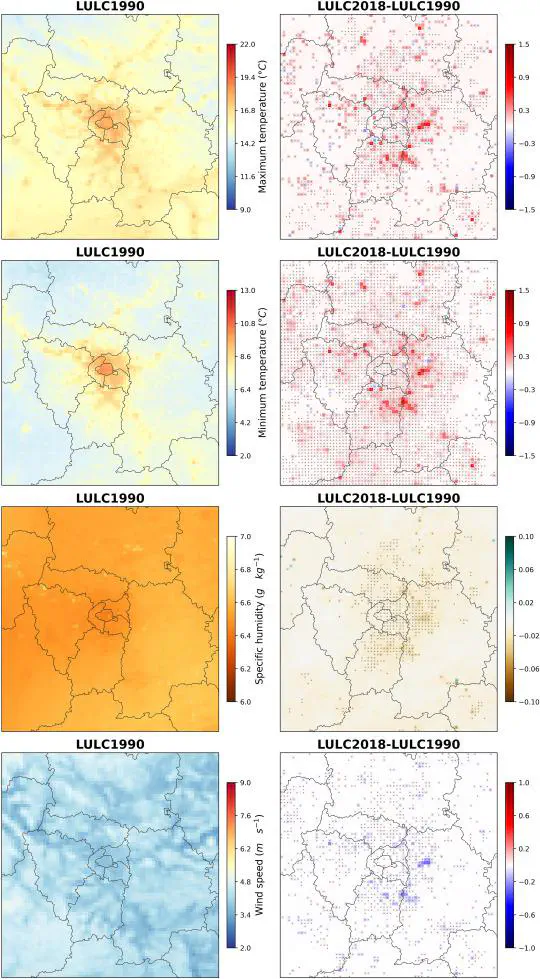
The new generation of Convection-Permitting Regional Climate Models (CP-RCM), coupled inline with surface models, provides an ideal framework for urban-scale impact studies. To this end, it is essential to accurately represent cities, both physically and spatially. Taking the Paris region (France) and a continuous time period (2000-2022) as a case study, two simulations conducted by the CNRM-AROME CP-RCM (2.5~km horizontal resolution), coupled to the TEB Urban Canopy Model and based on two different LULC maps from 1990 and 2018, are analysed. This study provides a systematic overview of the past urban growth effects on regional climate and local air warming trends, informed by both modeling and observations. Significant effects of urban expansion are notable for various meteorological variables (nighttime/daytime temperatures, wind speed, specific humidity), sometimes beyond the urbanised grid points; these effects are stronger for extreme values, with seasonal contrasts. By comparing these results to observational data from weather stations, the added-value of updating the LULC map in CNRM-AROME is assessed. The spatial disparity in warming trends observed among weather stations could be partially explained by urban growth. In line with other studies, this paper argues for the consideration of urban dynamics in climate models by insisting on the benefits that a dynamic evolution of the LULC map would have, at least for urban areas, in CP-RCMs, whether it is for historical or future climate simulations.